
Artist Statement
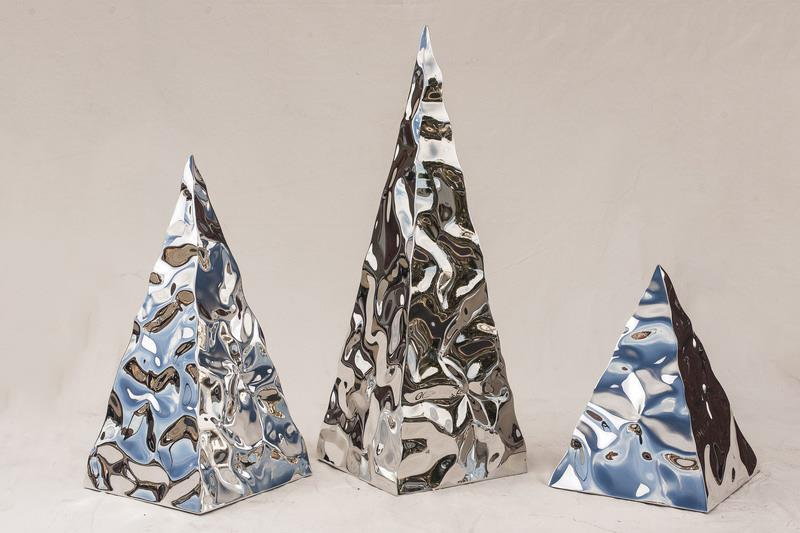
The Pyramids rework one of the oldest sculptural archetypes into a contemporary language of reflection and flow. Each pyramid begins as a clear geometric volume, then its stainless-steel skin is pressed into soft, uneven waves that break up the planes. The result is a trio of peaks that remain sharp in outline, yet behave optically like a moving, metallic terrain.
Seen as a group, the three scales suggest a small topography—related but not identical forms, each catching light and color in a different way. Surroundings, architecture and viewers fragment across their faces, sliding from one pyramid to the next. The work invites the eye to travel between them, tracing lines of reflection that link the individual pieces into a single sculptural constellation.
Whether installed as a tight cluster or with more space between them, The Pyramids play with ideas of monumentality, memory and mirage: ancient silhouettes rendered in liquid metal.
1/1 Installation
Display the three pyramids as a group, allowing enough floor space for viewers to walk around them. A neutral floor and backdrop help the reflective surfaces read clearly. Use soft, even lighting (3000–4000 K) from above and the sides to bring out the relief on each face without strong glare. The work suits galleries, lobbies, terraces and outdoor courtyards where natural light can shift across the forms throughout the day.
1/2 Relational Works
Good conceptual/visual companions on the site:
Liquid Mercury II – dense relief exploring similar wave patterns
Obelisk – tall reflective monument with faceted top
Mercury Column – slender vertical form with liquid surface
The Wedge – sharply profiled reflective volume


